The brief history of colors
blue is my preference …
The turning point for blue occurred in the Middle Ages, where it experienced a spectacular rise in the collective and spiritual imagination. The Catholic Church played a key role in this transformation. Starting in the 12th century, it began to favor this color, which it deemed more calming and wise than red, often associated with passion and violence. Blue was then used to enhance the stained-glass windows of Gothic cathedrals, as evidenced by Abbot Suger during the reconstruction of the Abbey Church of Saint-Denis around 1130. For him, the blue of the stained glass was meant to “dispel darkness” and elevate the souls of the faithful toward divine light.
At the same time, the Virgin Mary was depicted for the first time wearing an azure mantle. This innovation marked a decisive step in Christian symbolism: blue became a symbol of purity, spirituality, and elevation. Its popularity was reinforced by the rarity and preciousness of the pigments needed to create it. Ultramarine pigment, derived from lapis lazuli, was extremely expensive, even more costly than gold. Its extraction required complex expertise to transform the raw stone into a fine powder, allowing for intense and durable colors. Along with vermilion and gold, it formed what artists called the “royal trio” of the medieval palette.
This rarity conferred an elite status upon blue. Initially reserved for the sacred, it gradually became prevalent among aristocratic elites. Blue clothing became a sign of distinction, and indigo dye, extracted from certain plants, gradually spread across Europe, democratizing this color.
Today, blue embodies an infinite palette of meanings: it symbolizes both serenity and infinity, elegance and modernity. This duality reflects its long journey through history, from the first artisanal experiments to the universal symbols of our time. As Michel Pastoureau emphasizes, the history of blue is that of a color that has managed to capture the hearts of societies, becoming almost universally loved.
Blue reached its symbolic and artistic peak in the 20th century, notably thanks to Yves Klein, who made it a cornerstone of his work. In 1954, the artist began a period entirely dedicated to this color. Fascinated by its depth and spirituality, Klein asked paint dealer Edouard Adam to create a unique ultramarine blue, vibrant and luminous, for him. This pigment was patented under the name IKB (International Klein Blue) at the French National Institute of Industrial Property. Faithful to this shade until his death, Yves Klein made it a universal symbol of infinity and immateriality.
In 1957, his exhibition in Milan, titled “Monochrome Propositions – Blue Period,” marked a turning point in the history of contemporary art. The exhibition, composed of eleven entirely monochrome works, all dedicated to blue, was conceived as a true artistic manifesto. Klein declared, “Blue has no dimension. It is beyond the dimensions that other colors participate in.” For him, this color acted as a passage to the invisible, making tangible what escapes the eye. This revolutionary and poetic concept, where blue becomes a vector of transcendence, still resonates today as one of the pillars of modern art.
However, long before Yves Klein, blue already occupied an important place in modern and Symbolist art. At the beginning of the 20th century, Paul Cézanne asserted: “Blue gives its vibrations to other colors,” illustrating its central role in the harmony of artistic palettes. Pablo Picasso, on the other hand, made history with his famous “Blue Period,” which spanned from 1901 to 1904. During this time, the artist explored shades of sadness, solitude, and melancholy through deep blue tones, giving his works unprecedented emotional power. This period marked a turning point in Picasso’s career, revealing an introspective and humanistic side to his art.
Artists’ love for blue also endured with Wassily Kandinsky, one of the pioneers of abstract art. In 1911, Kandinsky created the avant-garde group Der Blaue Reiter (“The Blue Rider”) with Franz Marc, exploring spirituality in art. For Kandinsky, blue was a transcendent color, capable of evoking a profound and contemplative experience. He stated, “The power of deep understanding lies in blue.” This color, which he associated with purity and infinity, became a central element in his exploration of abstract forms and universal emotions.
The importance of blue in art continued to grow thanks to advances in physical chemistry, which in the 20th century enabled the development of new shades and pigments. These innovations offered artists unprecedented opportunities to express their vision and elevate their works. Blue, by turns a symbol of spirituality, modernity, and mystery, continues to hold a special place in the collective and artistic imagination.

Michel Pastoureau : Archivist and paleographer, he was Director of Studies at the École Pratique des Hautes Études from 1982 to 2016. He is a specialist in the history of symbolic systems…
The red color
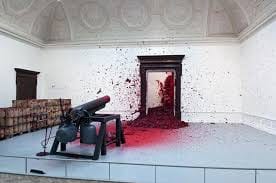
In Berlin in 2009, Anish Kapoor installed a monumental cannon that fired projectiles of red wax. These projectiles, in a mechanical and almost ritualistic repetition, smashed against a pristine white wall, gradually staining it with the color of blood. This artistic gesture, both spectacular and unsettling, explored the interplay between raw material, color, and time. The following year, at New York’s Guggenheim Museum, Kapoor continued his exploration with an installation where a cloud of scarlet powder suddenly exploded into the air, saturating the space in red while a backdrop of blue evoked a sense of celestial calm. This stark contrast between fiery red and tranquil blue symbolized a universal tension: the clash between emotion and serenity, chaos and order.

These artistic experiments marked a pivotal moment in Kapoor’s use of red as a tool of expression. For him, colors are not mere pigments; they are forces. Red, vibrant, warm, and magnetic, draws the eye irresistibly, while blue, cold and distant, seems to retreat. Through this dialogue of opposites, Kapoor questions the very balance of forces and symbols that shape our perceptions.
In 2011, during the Monumenta exhibition at the Grand Palais in Paris, Kapoor once again left a lasting impression by inviting visitors into a massive, air-filled sculpture. This organic, immersive space, bathed in muted light, altered perceptions of matter and volume. Once again, red played a central role, dominating the space and provoking ambiguous sensations—simultaneously enveloping and oppressive. The material seemed alive, in motion, and impossible to grasp. Kapoor compelled his audience to confront extreme emotions, reminding them that red, beyond its beauty, is an ambivalent color capable of evoking both life and death, passion and destruction.
Red, indeed, carries a singular symbolic weight. As the color of blood and fire, it represents life and power, but also violence, anger, and excess. Since prehistoric times, humans have been captivated by this hue. As early as the Neolithic period, they created red pigments using madder root, a plant with dye-rich properties. In antiquity, bright red became a symbol of authority, embraced by emperors and ruling classes to assert their dominance. During the Middle Ages, both laity and clergy adopted the color to signify wealth and the sacred. Yet in the 16th century, the Protestant Reformation disrupted this legacy. Red became associated with the “papists” and the Whore of Babylon, a biblical figure of immorality. It fell out of favor in certain parts of Europe, losing its former glory, although it remained deeply tied to Catholic pomp and ceremony.
Despite this temporary decline, artists never abandoned red. Venetian painters like Titian and Tintoretto made it a defining feature of their sumptuous canvases, playing with dazzling drapery. El Greco, in turn, used red to magnify his religious figures, as seen in his unforgettable depiction of Christ draped in a crimson robe. Later, Baroque painters elevated red to dramatic heights, utilizing its vibrant tones to enhance the emotional power of their compositions.
In the modern era, red experienced a renaissance. The artistic movements of the 19th and 20th centuries, driven by a thirst for freedom and experimentation, embraced red in all its variations: ochre, crimson, magenta, vermilion. For Joan Miró, red was luminous and playful; for Niki de Saint Phalle, it was explosive and brimming with energy. In 2005, Annette Messager won the Golden Lion at the Venice Biennale with her installation Casino, inspired by Pinocchio. In this work, a vast red sheet evoked the passage to life, demonstrating the enduring power of a color that, far from being neutral, resonates universally.
For Michel Pastoureau, a historian specializing in colors, red is more than just a pigment—it is a symbol imbued with history and emotion. In Latin, the word coloratus signifies both red and color itself. Similarly, in Slavic languages like Russian, the word krasny means both “red” and “beautiful.” This duality reflects the cultural and aesthetic importance of red, which naturally emerged as a dominant hue in the earliest forms of art. Vivid, radiant, and profoundly human, red continues to captivate with its ambivalence. It is both alluring and threatening, warm and aggressive, vital and destructive.
Kapoor, like many artists before him, explores this duality with passion, elevating red to the level of obsession. His works, whether monumental or delicate, challenge our perceptions, emotions, and relationship to the world. In his hands, red becomes a universal language, capable of expressing both beauty and pain, the ephemeral and the eternal. It is a color that can never leave anyone indifferent.
The yellow and green colors
In the race to claim the third primary color, yellow and green engage in a fascinating and complex rivalry. These two colors, so deeply interconnected, share a history intertwined with art, science, and symbolism. Yet, each carries its own unique challenges and baggage that have shaped its place in collective imagination over the centuries.
Green, one of the three primary colors in additive synthesis (alongside red and blue), embodies a paradox. While it plays a fundamental role in the science of light and color perception, its history in art has been far more tumultuous. Difficult to produce and even harder to stabilize, green pigments often faded quickly over time. The materials available to artists for centuries were unreliable, costly, or, in some cases, dangerously toxic. The infamous “Paris Green” and “Scheele’s Green,” for instance, contained arsenic and posed serious health risks to artists, dyers, and even the wearers of green fabrics.
As a result, green developed an ambivalent reputation. While it symbolized the vitality of nature, renewal, and hope, it was equally associated with instability, chance, poison, and even death. This duality gave green an enigmatic place in the cultural and artistic lexicon. Few exceptions, such as Veronese’s use of radiant greens in his luminous compositions, dared to elevate the color in earlier centuries. For the most part, green remained marginal in the hierarchy of colors, only gaining prominence during the modern era, when artists like the Impressionists began to explore its richness and versatility.
Yellow, by contrast, presented an entirely different set of challenges. Unlike green, yellow was relatively easy to produce, with natural pigments like ochre and saffron providing vibrant hues. However, yellow carried an overwhelmingly negative symbolic weight that hindered its wider adoption.
From the Middle Ages onward, yellow came to represent betrayal, deceit, and lies. It became the color of stigma, marking the clothing of traitors, heretics, and, most notably, Judas Iscariot, the archetype of betrayal in Christian tradition. Paradoxically, despite being the color of the sun—an emblem of life and light—yellow never fully shone in medieval iconography. Instead, gold, with its shimmering brilliance, became the preferred color for evoking the divine and the sacred. Saints’ halos and religious artifacts radiated with gold, leaving yellow relegated to a lesser, profane status.
Yet yellow’s story did not end there. By the late 19th century, revolutionary artists reclaimed the color, uncovering its expressive power and lifting it out of its symbolic shadows. Vincent van Gogh, for instance, used yellow with an intensity unmatched in earlier works, transforming sunflowers, wheat fields, and blazing skies into symbols of vitality, emotion, and hope. Among the Fauves, yellow burst onto the canvas with boldness and energy, representing creative freedom and raw artistic expression.
Green, too, underwent a renaissance during this time. The Impressionists, enchanted by nature’s shifting light and hues, embraced green as a central element of their work. In the paintings of Monet and Renoir, the greens of gardens, foliage, and water shimmered with life, capturing the ephemeral beauty of the natural world. Later, modernists such as Henri Matisse and Paul Klee explored green’s abstract and emotional potential, using it to evoke harmony, mystery, and balance far beyond its descriptive role.
Today, both yellow and green have shed much of their historical baggage. In contemporary art, they are celebrated as powerful tools of expression, capable of conveying serenity and provocation, joy and ambiguity. Their journeys illustrate how cultural perceptions evolve over time, shaped by technical innovations, societal changes, and the daring visions of artists.
Thus, in their competition for the third spot on the podium of primary colors, yellow and green have continued to complement and enrich each other. Yellow, with its warmth and solar energy, radiates immediate vibrancy, while green, rooted in the earth, offers a soothing yet enigmatic counterbalance. Together, they enrich our visual world, providing an endless spectrum of sensations and emotions.
Black and white : colors ?
Who decreed that black and white were not colors?
Certainly not the artists, who have been using these two hues since time immemorial. Alongside red, white represents one of the three foundational colors in the symbolism of visual perception. In the early 19th century, dandies, poets, and painters—struck by the “black sun of melancholy” in Gérard de Nerval’s writings—were not hesitant to explore atmospheres drenched in dark tones. Some Impressionists, too, were drawn to these contrasts, including Manet, who unreservedly embraced darker shades.
White made its explosive entry into the world of art, thanks to Kazimir Malevitch and his groundbreaking White Square on White Background, the first monochrome work in the history of modern art. Malevitch famously declared, “I have pierced the blue lampshade of colored sensations, and I have entered into the white. Sail forth in my wake, comrades, aviators of the void, and I have established the semaphore of suprematism.” His non-objective forms, created with his colleagues, showcased both white and black as equal partners in this radical departure from traditional color theory.
In 1946, Paris’s Maeght Gallery boldly proclaimed: “Black is a color.” This statement resonated deeply in the work of Pierre Soulages, who devoted his life to exploring the expressive power of black. In 1979, Soulages coined the term outrenoir to describe works where black becomes a medium of light. “Black is a living color for me,” he remarked, emphasizing its dynamic and transformative quality.
White, too, found its loyal champion. Since 1955, the American artist Robert Ryman has created works dominated by shades of white, which he believed were most capable of reflecting light and highlighting all other elements within a painting: the brushstroke, the pigment, even the structure of the canvas. Both Soulages and Ryman sought an absolute purity where the interplay between material and light transcended traditional boundaries of color.
In the ancient and medieval worlds, both black and white held significant roles. White was used to illuminate faded parchment and to highlight natural materials like wood, stone, and unprocessed fabric. Black, sourced directly from nature (such as from charcoal), was viewed as a full-fledged color. The distinction was often made between matte and shiny black, offering a variety of expressive possibilities.
However, the 15th century brought about a revolutionary change. With the advent of printing, black-and-white images gradually replaced the colorful, hand-painted images of the past. At the same time, scientific advances, particularly Isaac Newton’s theory, which demonstrated that light was a mixture of all colors in the spectrum, effectively sidelined black and white as “non-colors.”
For nearly three centuries, black and white were thus regarded as something apart from the realm of colors, forming their own universe separate from the rich, chromatic world of hues. This transformation is aptly summarized by art historian Johann Winckelmann, who observed that “the acceptance of black and white as mere shadows of true color heralded a major shift in how we relate to the physical and metaphysical worlds.”
But once again, artists rebelled against these rigid scientific definitions. While Leonardo da Vinci—who straddled both the artistic and scientific worlds—did not consider black to be a “true” color, many other master artists gave black a central role in their works. Dutch painters like Frans Hals and Anthony van Dyck embraced black in their somber portraits, aligning with the austere sensibilities of the Protestant Reformation.
In Italy, Caravaggio elevated black to a central role in his chiaroscuro technique, which would deeply influence a generation of artists. In Spain, Francisco de Goya’s Pinturas Negras (1819–1823)—an ensemble of fourteen haunting frescoes painted directly onto the walls of his home, the Quinta del Sordo—conveyed a psychological intensity that made black not just a color but an existential statement.
These works are a testament to the dramatic power and symbolic weight that black and white have held across history. Reclaiming their positions as forces of emotional and artistic expression, these two “non-colors” challenge the conventions of what it means to perceive and create. Their story is one of reclamation—where scientific theories and cultural biases were overturned by artists who refused to let the binary opposition of black and white remain within the confines of outdated thinking.

Johann Winckelmann (1717-1768) was a German art historian and archaeologist, widely regarded as one of the founders of the discipline of art history. He is best known for his studies of ancient Greek art and for contributing to the rise of Neoclassicism in Europe. Pioneer of Art History: Winckelmann was one of the first to approach art in a systematic and theoretical way. Before him, art was often studied in a more empirical or practical manner. Winckelmann developed a method of analyzing artworks that marked a turning point in the study of aesthetics and art history. "History of Art in Antiquity": Published in 1764, this book is one of his major contributions. In it, he provides a detailed analysis of the works of ancient Greece, which he considered the pinnacle of artistic beauty. He expressed the idea that Greek art achieved formal perfection and that this perfection should be imitated.